Linux static_call*
Avoiding retpolines with static calls
[PATCH v2 02/13] static_call: Add basic static call infrastructure
PATCH v2 06/13 x86/static_call: Add inline static call implementation for x86-64
Linux Kernel 5.10 Introduces Static Calls to Prevent Speculative Execution Attacks
Tldr
在看 KVM 代码时发现有 static_call(kvm_x86_run)(vcpu) 的用法,查了一下,涉及到 Linux 新引入的 static_call 机制。
从调用代码开始分析,即 static_call(kvm_x86_run),相关的宏定义有:
// include/linux/static_call_types.h
#define STATIC_CALL_TRAMP_PREFIX    __SCT__
#define STATIC_CALL_TRAMP_PREFIX_STR    __stringify(STATIC_CALL_TRAMP_PREFIX)
#define STATIC_CALL_TRAMP_PREFIX_LEN    (sizeof(STATIC_CALL_TRAMP_PREFIX_STR) - 1)
#define STATIC_CALL_TRAMP(name)     __PASTE(STATIC_CALL_TRAMP_PREFIX, name)
#define STATIC_CALL_TRAMP_STR(name) __stringify(STATIC_CALL_TRAMP(name))

#define __raw_static_call(name) (&STATIC_CALL_TRAMP(name))
/*
 * __ADDRESSABLE() is used to ensure the key symbol doesn't get stripped from
 * the symbol table so that objtool can reference it when it generates the
 * .static_call_sites section.
 */
#define __STATIC_CALL_ADDRESSABLE(name) \
    __ADDRESSABLE(STATIC_CALL_KEY(name))

#define __static_call(name)                     \
({                                  \
    __STATIC_CALL_ADDRESSABLE(name);                \
    __raw_static_call(name);                    \
})

#define static_call(name)   __static_call(name)
将 static_call(kvm_x86_run)(vcpu) 展开得到(其中 ADDRESSABLE 用于确保符号不从符号表中删除,这里就不展开了):
({
  __STATIC_CALL_ADDRESSABLE(kvm_x86_run)
  &__SCT__kvm_x86_run
})(vcpu)
那么这种形式是如何最终调用到 vmx_vcpu_run 的呢。
首先来看没有 static_call 的情况。在 arch/x86/kvm/x86.c 中,声明了 kvm_x86_ops 结构体,类型是 kvm_x86_ops(以下不指明类型,说的都是作为变量的 kvm_x86_ops),其成员是一堆函数指针,即 x86 架构下 KVM 的各种操作。对 x86.c 来说,并不关心底层是 AMD 还是 Intel,只要能实现 kvm_x86_ops 中的函数就行。
以 VMX 为例,在 arch/x86/kvm/vmx/vmx.c 中实现各种操作函数,并将其赋给一个 kvm_x86_ops 类型的 vmx_x86_ops。而 x86.c 中如何访问其中的函数呢,是通过 VMX 初始化函数 vmx_init 实现的。
vmx_init 是 kvm-intel 模块的初始化函数,它会调用 kvm_init,即 KVM 的初始化函数,传入的参数就有 vmx_init_ops。定义如下:
static struct kvm_x86_init_ops vmx_init_ops __initdata = {
    .cpu_has_kvm_support = cpu_has_kvm_support,
    .disabled_by_bios = vmx_disabled_by_bios,
    .check_processor_compatibility = vmx_check_processor_compat,
    .hardware_setup = hardware_setup,

    .runtime_ops = &vmx_x86_ops,
};
其中的 runtime_ops 成员指向了 vmx_x86_ops。而在 kvm_init 中,会调用 kvm_arch_hardware_setup。其中就会把 ops->runtime_ops 的值复制到 kvm_x86_ops 中, 也就是将 vmx_x86_ops 的函数指针值暴露给 x86.c。这样,x86.c 中的函数就可以通过 kvm_x86_ops.func 调用所需的操作函数,如在 vcpu_enter_guest 中就可以调用 kvm_x86_ops.run 从而调用 vmx_vcpu_run 进入 VM 执行。
以上是没有 static_call 的情况,而在引入了 static_call 机制之后。在声明 kvm_x86_ops 后,定义了一个宏 KVM_X86_OP:
// include/linux/static_call_types.h
#define STATIC_CALL_KEY_PREFIX      __SCK__
#define STATIC_CALL_KEY_PREFIX_STR  __stringify(STATIC_CALL_KEY_PREFIX)
#define STATIC_CALL_KEY_PREFIX_LEN  (sizeof(STATIC_CALL_KEY_PREFIX_STR) - 1)
#define STATIC_CALL_KEY(name)       __PASTE(STATIC_CALL_KEY_PREFIX, name)
#define STATIC_CALL_KEY_STR(name)   __stringify(STATIC_CALL_KEY(name))

struct static_call_key {
    void *func;
    union {
        /* bit 0: 0 = mods, 1 = sites */
        unsigned long type;
        struct static_call_mod *mods;
        struct static_call_site *sites;
    };
};

#define DECLARE_STATIC_CALL(name, func)                 \
    extern struct static_call_key STATIC_CALL_KEY(name);        \
    extern typeof(func) STATIC_CALL_TRAMP(name);

// arch/x86/include/asm/static_call.h

#define __ARCH_DEFINE_STATIC_CALL_TRAMP(name, insns)            \
    asm(".pushsection .static_call.text, \"ax\"     \n" \
        ".align 4                       \n" \
        ".globl " STATIC_CALL_TRAMP_STR(name) "     \n" \
        STATIC_CALL_TRAMP_STR(name) ":          \n" \
        insns "                     \n" \
        ".type " STATIC_CALL_TRAMP_STR(name) ", @function   \n" \
        ".size " STATIC_CALL_TRAMP_STR(name) ", . - " STATIC_CALL_TRAMP_STR(name) " \n" \
        ".popsection                    \n")

#define ARCH_DEFINE_STATIC_CALL_NULL_TRAMP(name)            \
    __ARCH_DEFINE_STATIC_CALL_TRAMP(name, "ret; nop; nop; nop; nop")

// include/linux/static_call.h
#define DEFINE_STATIC_CALL_NULL(name, _func)                \
    DECLARE_STATIC_CALL(name, _func);               \
    struct static_call_key STATIC_CALL_KEY(name) = {        \
        .func = NULL,                       \
        .type = 1,                      \
    };                              \
    ARCH_DEFINE_STATIC_CALL_NULL_TRAMP(name)

// arch/x86/kvm/x86.c
#define KVM_X86_OP(func)                         \
    DEFINE_STATIC_CALL_NULL(kvm_x86_##func,              \
                *(((struct kvm_x86_ops *)0)->func));
#define KVM_X86_OP_NULL KVM_X86_OP
在 arch/x86/include/asm/kvm-x86-ops.h 中使用了这个宏:
...
KVM_X86_OP(run)
KVM_x86_OP_NULL(handle_exit)
...
其实就是为 kvm_x86_ops 结构体类型的函数指针成员创建对应的 static_call。以 KVM_X86_OP(run) 为例,展开得到:
extern struct static_call_key __SCK__kvm_x86_run;
extern typeof(run) __SCT__kvm_x86_run;
struct static_call_key __SCK__kvm_x86_run = {
  .func = NULL,
  .type = 1,
};
asm(".pushsection .static_call.text, \"ax\"     \n" \
        ".align 4                       \n" \
        ".globl " __SCT__kvm_x86_run "      \n" \
        __SCT__kvm_x86_run ":           \n" \
        ret; nop; nop; nop; nop "                       \n" \
        ".type " __SCT__kvm_x86_run ", @function    \n" \
        ".size " __SCT__kvm_x86_run ", . - " __SCT__kvm_x86_run " \n" \
        ".popsection                    \n")
通过 KVM_X86_OP 在二进制文件中为符号 __SCT__kvm_x86_run 创建了一个临时的 trampoline,临时是因为在之后就会更新。
上面提到,在 kvm_arch_hardware_setup 中,会将 vmx_x86_ops 的值复制到 kvm_x86_ops,而在启用 static_call 机制后,紧接着要做的就是调用 kvm_ops_static_call_update 更新由 kvm-x86-ops.h 中定义的 static_call。
static inline void kvm_ops_static_call_update(void)
{
#define KVM_X86_OP(func) \
    static_call_update(kvm_x86_##func, kvm_x86_ops.func);
#define KVM_X86_OP_NULL KVM_X86_OP
#include <asm/kvm-x86-ops.h>
}
重新定义了 KVM_X86_OP 然后更新所有的函数指针的 static_call。
// include/linux/static_call.h
#define STATIC_CALL_TRAMP_ADDR(name) &STATIC_CALL_TRAMP(name)

#define static_call_update(name, func)                  \
({                                  \
    typeof(&STATIC_CALL_TRAMP(name)) __F = (func);          \
    __static_call_update(&STATIC_CALL_KEY(name),            \
                 STATIC_CALL_TRAMP_ADDR(name), __F);    \
})
还是以 KVM_X86_OP(run) 为例,展开得到:
typeof(__SCT__kvm_x86_run) __F = kvm_x86_ops.run;
__static_call_update(&__SCK__kvm_x86_run, &__SCT__kvm_x86_run, __F);
实际更新的操作在 __static_call_update 中:
// kernel/static_call.c
void __static_call_update(struct static_call_key *key, void *tramp, void *func)
{
    struct static_call_site *site, *stop;
    struct static_call_mod *site_mod, first;

    cpus_read_lock();
    static_call_lock();

    if (key->func == func)
        goto done;

    key->func = func;

    arch_static_call_transform(NULL, tramp, func, false);
  ...
}
后面的代码比较复杂,出现了两个结构体 static_call_mod 和 static_call_site。其实在之前已经用过,在 static_call_key 中有一个 union 成员:
// include/linux/static_call_types.h
struct static_call_key {
    void *func;
    union {
        /* bit 0: 0 = mods, 1 = sites */
        unsigned long type;
        struct static_call_mod *mods;
        struct static_call_site *sites;
    };
};

/*
 * The static call site table needs to be created by external tooling (objtool
 * or a compiler plugin).
 */
struct static_call_site {
    s32 addr;
    s32 key;
};

// include/linux/static_call.h
struct static_call_mod {
    struct static_call_mod *next;
    struct module *mod; /* for vmlinux, mod == NULL */
    struct static_call_site *sites;
};
暂时不去管其中的细节,只关心对于 KVM_X86_OP(run) 是如何实现 static_call(kvm_x86_run) 调用 vmx_vcpu_run 的。
__static_call_update 的三个参数分别为:&__SCK__kvm_x86_run, &__SCT__kvm_x86_run, vmx_vcpu_run,而在其中的 arch_static_call_transform 函数中有:
// arch/x86/kernel/static_call.c
static inline enum insn_type __sc_insn(bool null, bool tail)
{
    /*
     * Encode the following table without branches:
     *
     *  tail    null    insn
     *  -----+-------+------
     *    0  |   0   |  CALL
     *    0  |   1   |  NOP
     *    1  |   0   |  JMP
     *    1  |   1   |  RET
     */
    return 2*tail + null;
}

static void __ref __static_call_transform(void *insn, enum insn_type type, void *func)
{
    const void *emulate = NULL;
    int size = CALL_INSN_SIZE;
    const void *code;

    switch (type) {
    ...

    case JMP:
        code = text_gen_insn(JMP32_INSN_OPCODE, insn, func);
        break;
  ...
  }

    if (memcmp(insn, code, size) == 0)
        return;

    if (unlikely(system_state == SYSTEM_BOOTING))
        return text_poke_early(insn, code, size);

    text_poke_bp(insn, code, size, emulate);
}

void arch_static_call_transform(void *site, void *tramp, void *func, bool tail)
{
    mutex_lock(&text_mutex);

    if (tramp) {
        __static_call_validate(tramp, true);
        __static_call_transform(tramp, __sc_insn(!func, true), func);
    }
...
}
__static_call_transform 参数为 &__SCT__kvm_x86_run, JMP, vmx_vcpu_run,调用 text_gen_insn 生成一个目的地址为 vmx_vcpu_run 的 JMP 指令,然后使用 text_poke_early 将这条指令复制到 __SCT__kvm_x86_run 处,覆盖之前的 ret。
即将 ` 处指令替换为目标为的 JMP 指令。tramp即__SCT__kvm_x86_run从原来的ret; nop; nop; nop; nop替换了JMP vmx_vcpu_run`。
现在,执行到 static_call(kvm_x86_run) 即指令 call __SCT__kvm_x86_run,执行 JMP vmx_vcpu_run,即跳转到目标函数,JMP 没有改变栈结构,在 ret 时会直接返回到之前 call 指令压栈的返回地址,即调用 static_call(kvm_x86_run) 处。
仍存在的问题是还是依赖于 trampoline,根据 include/linux/static_call.h 中的注释和各种 patch 的相关说明,启用 static_call inline 会在系统运行时 patch 内核,直接调用目标函数。
在 __static_call_update 函数的后半段,根据 key 对应的 mod 和 site 进行处理。但对于 KVM 中的 static_call,在定义之后没有看到对 mod 和 site 的修改,所以这里暂且认为都是 NULL(key 中的 type, mod, site 组成 union,定义是只设置了 type=1,而在后续使用 mod 或 site 的时候做了 &~1 的操作,也就是去掉了 type)。
那这样似乎 KVM 并没有做 inline static_call 的优化。放下代码,去看实际的二进制文件。
在 kvm.ko 文件中的 static_call(kvm_x86_run) 部分如下:


搜索 __SCK__kvm_x86_run,在 .static_call_sites 段中找到:

这个 offset 是 ida 的分析结果,而转换成十六进制为:

这个段里的数据应该都是 static_call_site 结构体,也就是 addr 和 key,这让我联想到在看 __static_call_update 函数时看到两个函数:
static inline unsigned long __static_call_key(const struct static_call_site *site)
{
    return (long)site->key + (long)&site->key;
}

static inline void *static_call_addr(struct static_call_site *site)
{
    return (void *)((long)site->addr + (long)&site->addr);
}
两个函数都将 site 的成员与其地址相加,而在此处,我们也尝试做这样的运算得到:
>>> hex(0x6A34B8+0xFF98DD93)
'0x10003124b'
>>> hex(0x6A34BC+0xFFFEA714)
'0x10068dbd0'
前者是 addr+&addr,得到的是 call __SCT__kvm_x86_run 这条指令的地址,而后者是 key+&key,得到的是 __SCK__kvm_x86_run 的地址。
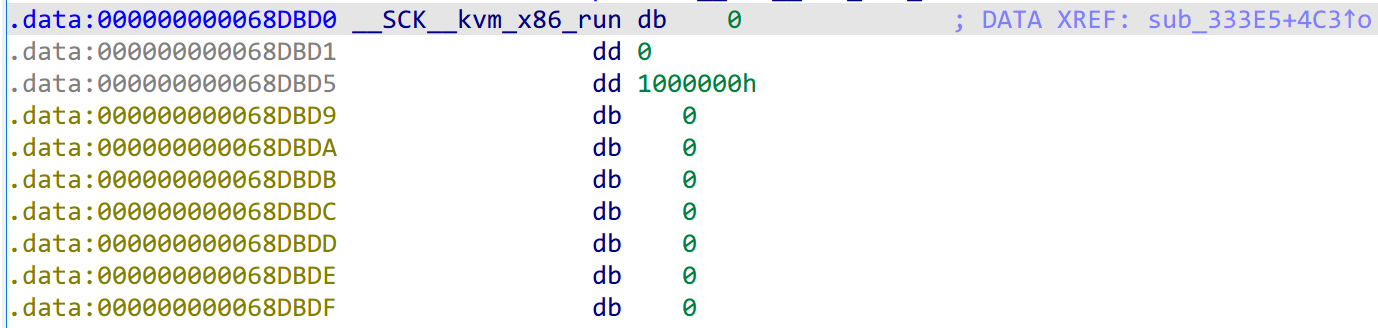
同时,我们还知道了,KVM 中 static_call 的 site 并不是 NULL,那问题就来了,是在哪里设置了 site。不急,姑且根据二进制文件里的值走一遍 __static_call_update 的后续流程。最终又会调用 arch_static_call_transform 函数,参数为 site_addr, NULL, vmx_vcpu_run, 0,其中 site_addr 就是 call 指令所在地址。也就是说这里即将 patch call 指令,将 static_call 从 trampoline 改为 inline。
static void __ref __static_call_transform(void *insn, enum insn_type type, void *func)
{
    const void *emulate = NULL;
    int size = CALL_INSN_SIZE;
    const void *code;

    switch (type) {
    case CALL:
        code = text_gen_insn(CALL_INSN_OPCODE, insn, func);
        if (func == &__static_call_return0) {
            emulate = code;
            code = &xor5rax;
        }
    ...
  ...
}

void arch_static_call_transform(void *site, void *tramp, void *func, bool tail)
{
    mutex_lock(&text_mutex);

  ...

    if (IS_ENABLED(CONFIG_HAVE_STATIC_CALL_INLINE) && site) {
        __static_call_validate(site, tail);
        __static_call_transform(site, __sc_insn(!func, tail), func);
    }

    mutex_unlock(&text_mutex);
}
还是调用 text_gen_insn 生成了一个目的地址为 vmx_vcpu_run 的 call 指令,覆盖到原 call 指令地址处,实现了 inline static_call 的优化。
查看 patch 后的二进制文件,gdb 双机调试,可以看到在 static_call(kvm_x86_run) 处指令为直接 callq 到 vmx_vcpu_run:
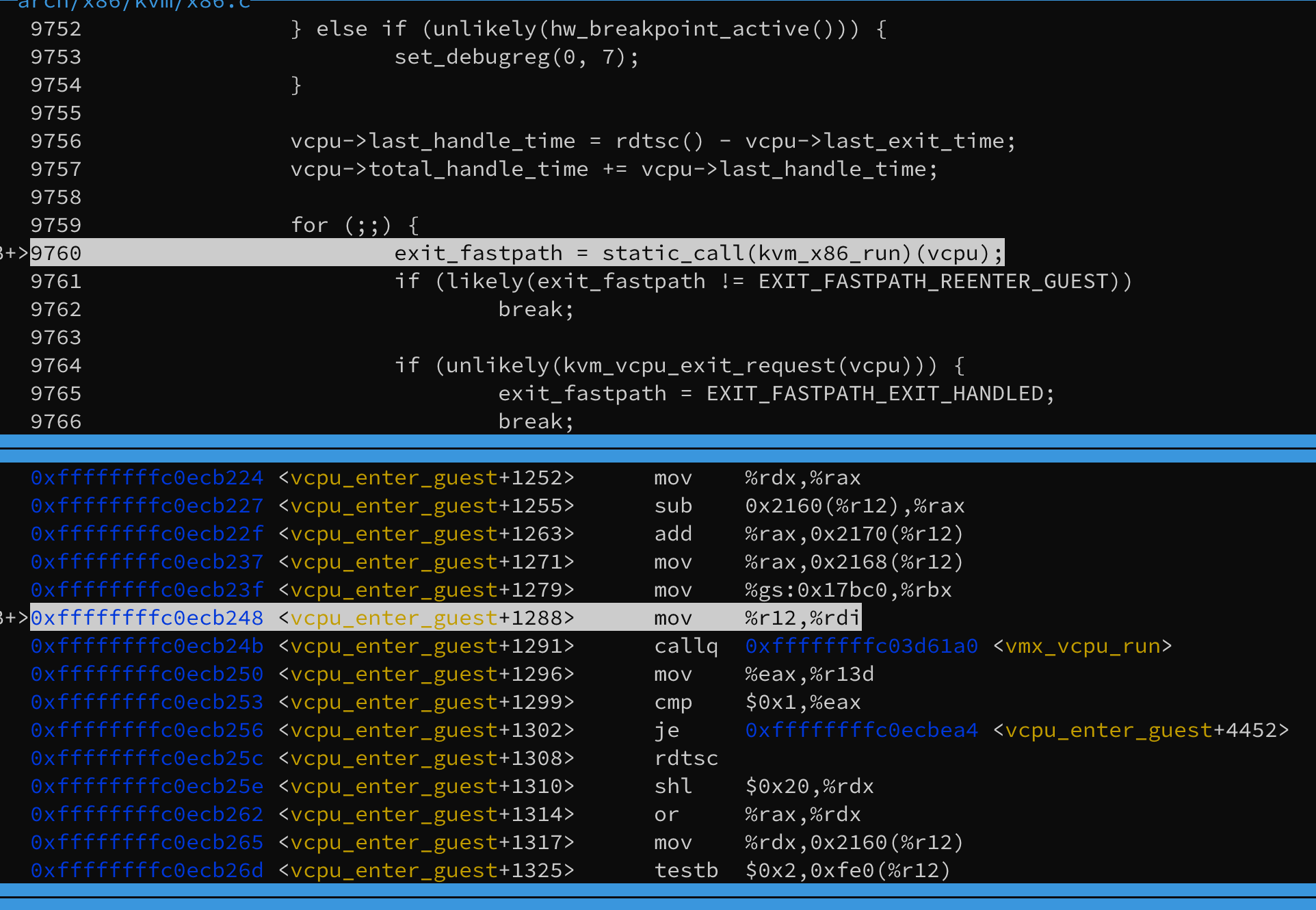
到这里,问题只剩下内核在哪里设置 static_call_site 的值。
回头再看几个 static_call 相关文件的注释:
// include/linux/static_call_types.h
/*
 * The static call site table needs to be created by external tooling (objtool
 * or a compiler plugin).
 */

// include/linux/static_call.h
/*
 * Implementation details:
 *
 *   If the arch has CONFIG_HAVE_STATIC_CALL_INLINE, then the call sites
 *   themselves will be patched at runtime to call the functions directly,
 *   rather than calling through the trampoline.  This requires objtool or a
 *   compiler plugin to detect all the static_call() sites and annotate them
 *   in the .static_call_sites section.
 */

// arch/x86/include/asm/static_call.h
/*
 * For CONFIG_HAVE_STATIC_CALL_INLINE, this is a temporary trampoline which
 * uses the current value of the key->func pointer to do an indirect jump to
 * the function.  This trampoline is only used during boot, before the call
 * sites get patched by static_call_update().  The name of this trampoline has
 * a magical aspect: objtool uses it to find static call sites so it can create
 * the .static_call_sites section.
 */
大概了解流程:
objtool 在编译时负责扫描 __SCT__ 开头的符号,构造 .static_call_sites 段,内核运行时先从这个段加载 mod 和 site 等数据结构,然后据此进行 static_call_update 操作。
过多的细节就不再展开,代码是看不完的,越看越多。